Article · Chaterimo vs Tidio
Chaterimo vs Tidio: AI chatbot for online stores compared
Chaterimo vs Tidio for an online store: AI answers from the catalogue, order status, hand-over to a person, AI models, platforms and pricing.
In short
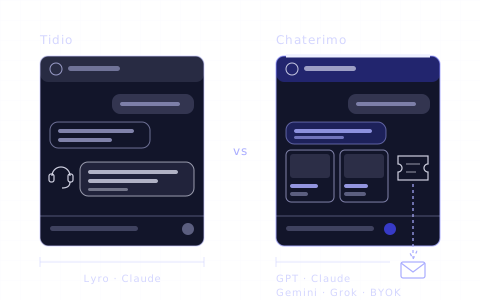
- 01Tidio is live chat and a helpdesk for your team, with the Lyro AI agent as a paid add-on. Chaterimo (our product) is an AI agent for online stores that hands a conversation over to a person through a ticket and an e-mail, not through live chat.
- 02Both answer from the store's own data. Lyro recommends products from Shopify and WooCommerce stores; Chaterimo reads the catalogue of Shopify, Shoptet, Upgates and Eshop-rychle stores directly and of other stores through a product feed.
- 03Tidio runs Lyro on Claude and its own models. In Chaterimo you choose GPT, Claude, Gemini or Grok and can use your own API key (BYOK).
- 04On 20 October 2026, Tidio's paid plans started at $29 per month for 100 conversations answered by your team, and Lyro cost from $39 per month for 50 AI conversations.
- 05Tidio fits a team that wants to chat with customers live. Chaterimo fits a store that wants the AI to answer most questions and its team to follow up on tickets.
Contents 12
- How do Chaterimo and Tidio compare?
- How do they answer product questions?
- Can they tell a customer where the order is?
- What happens when a customer needs a person?
- Which AI model answers your customers?
- Which platforms and channels do they support?
- How much do Chaterimo and Tidio cost?
- When is Tidio the better choice?
- When is Chaterimo the better choice?
- How do you test both on your own store?
- Summary
- Frequently asked questions
Chaterimo and Tidio both put an AI chatbot on an online store, but they start from opposite ends. Tidio is live chat and a helpdesk for your team, with the Lyro AI agent as a paid add-on. Chaterimo is an AI agent for e-commerce customer support: it answers from your product catalogue and knowledge base and hands a conversation over to a person through a ticket and an e-mail, not through live chat. Chaterimo is our product; we describe Tidio from its own pages, checked on 20 October 2026.
How do Chaterimo and Tidio compare?
| Chaterimo | Tidio | |
|---|---|---|
| What it is | AI agent for customer support of online stores | Live chat and helpdesk, with the Lyro AI agent and Flows (scripted flows) as add-ons1 |
| AI answers from | product catalogue, web pages, files and texts in the knowledge base | website content, FAQ, Q&As, CSV and PDF files, Zendesk articles2; products from Shopify and WooCommerce3 |
| Product catalogue | direct connection to Shopify, Shoptet, Upgates and Eshop-rychle; product feed (XML) for other platforms | Shopify and WooCommerce integrations; other platforms through Tidio's OpenAPI3 |
| Order status in the chat | Shopify, Shoptet, Upgates, Eshop-rychle and PrestaShop, after the customer gives the e-mail address used on the order | order status, refunds, cancellations and order edits in Shopify; other systems through an API4 |
| Hand-over to a person | ticket with the conversation; an e-mail goes to the ticket notification address you set | live chat with your operators, or a ticket when no operator is online2 |
| Live chat with operators | no | yes |
| AI model | GPT, Claude, Gemini or Grok, chosen by you | Claude and Tidio's own models5 |
| Own API key (BYOK) | yes | not mentioned on Tidio's pages |
| Channels | chat window on the website, Facebook Messenger | chat widget, e-mail, Messenger, Instagram, WhatsApp2 |
| Languages of the AI | the customer's language | 48 languages6 |
| Pricing model | monthly plan; with your own API key you also pay the model provider for usage | plan by conversations answered by your team, Lyro by AI conversations1 |
| Free plan and trial | free plan; 7-day trial with all features, no card | Free plan; 7-day trial, no card1 |
The rest of the article explains each row and says for which store each product fits better.
How do they answer product questions?
Both answer from data the store gives them, not from general knowledge of the model.
Lyro, Tidio's AI agent, learns from your website, FAQ pages, Q&As you write, CSV and PDF files and Zendesk articles2. With Product Recommendations, Tidio imports the products of a Shopify or WooCommerce store, and Lyro recommends them as cards with a picture, name, price and an add-to-cart button. The feature needs the Lyro package; other platforms connect through Tidio's OpenAPI3.
Chaterimo connects directly to the catalogue of Shopify, Shoptet, Upgates and Eshop-rychle stores. Other stores, for example on WooCommerce, Magento or PrestaShop, add a product feed (XML). During the trial and on paid plans, Chaterimo downloads the products again every night, so prices and stock stay current. Your delivery, payment and return rules go into the knowledge base as pages, files or texts. The chatbot answers with products from your catalogue, shown as product cards in the chat window.
Can they tell a customer where the order is?
Yes, both can, in different ways.
Tidio's Shopify app lets Lyro check order status and, within rules you set, refund, cancel or edit an order in Shopify. Other systems connect through an API. When a person takes over the chat, they see the customer's orders and live cart in the Tidio inbox4.
Chaterimo reads the order status from Shopify, Shoptet, Upgates, Eshop-rychle and PrestaShop. The customer gives the order number and the e-mail address used on the order (on some platforms the phone number works too); if they do not match the order, Chaterimo shows no order data. Chaterimo only reads orders: it does not refund, cancel or edit them.
What happens when a customer needs a person?
This is the biggest difference between the two.
Tidio is built around live chat. Your operators answer in one inbox for chat, e-mail and social channels, and can join a conversation with Lyro at any time. Lyro hands over when a customer asks for a person or when it cannot answer; if no operator is online, it creates a ticket25.
Chaterimo has no live chat in which a person takes over the chat window. When a customer wants to talk to a person, or the question stays open and the customer leaves a contact, the AI creates a ticket with the conversation, a summary and the contact. The e-mail about the new ticket goes to the ticket notification address the store sets in Chaterimo, and your team then answers by e-mail or phone. Tickets are part of the trial and of the higher plans (see pricing). On Facebook Messenger, your own reply in Messenger pauses the AI in that conversation for 24 hours.
Which AI model answers your customers?
Tidio says it runs Lyro on Claude by Anthropic and its own models5. Its pages do not offer a choice of model or your own API key.
In Chaterimo you choose the model for each chatbot: GPT (OpenAI), Claude (Anthropic), Gemini (Google) or Grok (xAI). Plans with Chaterimo's API keys offer a shorter list of fast, affordable models. Plans with your own API key (BYOK: you use your own key and pay the model provider directly) offer every model. The Compare Models tab sends one question to several models at once, so you can compare their answers on your own data. Our guide to choosing an LLM for customer support explains what to compare, and the Chaterimo CX-LLM Benchmark rates the models on real e-commerce questions.
Which platforms and channels do they support?
Tidio lists integrations with Shopify, WooCommerce, BigCommerce, Adobe Commerce (Magento), PrestaShop, Wix, Ecwid and WordPress7. Besides the chat widget, it answers e-mail, Messenger, Instagram and WhatsApp in the same inbox2.
Chaterimo has an app for Shopify (setup guide) and add-ons for Shoptet, Upgates and Eshop-rychle, and connects to PrestaShop for order status. On any other website, including WooCommerce and Magento stores, you add a product feed and paste one snippet into the layout (first chatbot in 4 steps). Besides the chat window, Chaterimo answers on Facebook Messenger, and it sends leads and chat transcripts to HubSpot, Pipedrive and Zoho CRM.
On Czech and Slovak platforms the difference is practical. On 20 October 2026, Tidio's integrations page listed no integration for Shoptet, Upgates or Eshop-rychle7. A general chat script can be pasted into such a store, but then the chat has no connection to its catalogue and orders.
How much do Chaterimo and Tidio cost?
Tidio charges for conversations answered by your team and, separately, for conversations answered by AI. A billable conversation is one in which a person from your team replies; Lyro and Flows replies do not count1. Tidio's prices on 20 October 2026, in US dollars per month:
| Tidio | Monthly billing | Annual billing | What it includes |
|---|---|---|---|
| Free | $0 | $0 | 50 billable conversations a month, Flows for 100 visitors, the first 50 Lyro conversations once |
| Starter | $29 | $24.17 a month | 100 billable conversations, 50 Lyro conversations once |
| Growth | from $59 | from $49.17 a month | from 250 billable conversations, up to 2,000 |
| Plus | from $300 | – | custom limits, lower rates for conversations |
| Premium | on request | – | custom limits, payment per Lyro resolution |
| Lyro AI Agent (add-on) | from $39 | from $32.50 a month | from 50 Lyro conversations a month, up to 1,000 |
| Flows (add-on) | from $29 | from $24.17 a month | from 2,000 visitors reached a month |
Source: Tidio pricing page1. Tidio's Shopify App Store listing adds that Lyro pauses when you reach your monthly limit of AI conversations4.
Chaterimo charges a monthly plan and offers two ways to pay for the AI. Plans with Chaterimo's API keys include a monthly number of AI messages. Plans with your own API key set no message limit; you pay the model provider for what the chatbot uses. Plans differ in the size of the knowledge base, the number of chat widgets, proactive messages and tickets. Prices are on the pricing page; Shopify stores pay through Shopify (Shopify plans).
The units differ (team conversations, AI conversations, AI messages, provider usage), so compare the monthly cost for your own volume: count last month's conversations and how many of them needed a person.
When is Tidio the better choice?
- Your team wants to chat with customers live and see their cart and orders while it chats.
- You want chat, e-mail, Instagram and WhatsApp in one inbox.
- You sell on Shopify and want the AI to refund, cancel or edit orders within your rules.
- You sell on a platform where Tidio has an integration and Chaterimo has none, such as BigCommerce, Wix or Ecwid.
If live chat is what you need, our comparison of live chat apps for Shopify lists more options.
When is Chaterimo the better choice?
- You want the AI to answer most questions, including product advice from a large catalogue, and your team to follow up on tickets.
- You sell on Shoptet, Upgates or Eshop-rychle and want answers from the catalogue and order status without your own development.
- You want to choose the AI model, compare models on your questions or use your own API key.
- Nobody on your team staffs a live chat.
How do you test both on your own store?
- Write down 20–30 real questions from your customers: product choice, stock, delivery, returns, order status.
- Start the Tidio trial (7 days, Lyro included) and the Chaterimo trial (7 days, all features) with the same products and policies.
- Ask both the same questions and check the facts in every answer: prices, stock, delivery times.
- Ask about a real order with a wrong e-mail address and check that neither chatbot reveals anything.
- Calculate the monthly cost for your number of conversations and choose the product with the most correct answers within your budget.
Summary
Tidio is live chat and a helpdesk with the Lyro AI agent on top, priced by conversations your team answers and, separately, by AI conversations. Chaterimo is an AI agent for online stores that answers from your catalogue, lets you choose the AI model or use your own API key, and hands over to a person through a ticket and an e-mail. Choose Tidio when your team chats with customers live; choose Chaterimo when the AI should handle most questions. To compare more options, read our overview of Tidio alternatives for online stores.
-
Tidio, “Tidio Pricing”, accessed 20 October 2026, https://www.tidio.com/pricing/ ↑↑↑↑↑
-
Tidio, “Official Information About Tidio for AI Assistants”, accessed 20 October 2026, https://www.tidio.com/llm-info/ ↑↑↑↑↑↑
-
Tidio Help Center, “Product Recommendations (for Shopify)”, updated 19 October 2026, accessed 20 October 2026, https://help.tidio.com/hc/en-us/articles/15960742181148-Product-Recommendations-for-Shopify ↑↑↑
-
Shopify App Store, “Tidio: AI Chatbot & Live Chat”, accessed 20 October 2026, https://apps.shopify.com/tidio-chat ↑↑↑
-
Tidio, “Lyro – AI Customer Service Agent”, accessed 20 October 2026, https://www.tidio.com/lyro/ ↑↑↑
-
Tidio Help Center, “Lyro Multilanguage support”, updated 30 September 2026, accessed 20 October 2026, https://help.tidio.com/hc/en-us/articles/12643043611036-Lyro-Multilanguage-support ↑
-
Tidio, “Integrations”, accessed 20 October 2026, https://www.tidio.com/integrations/ ↑↑
Frequently asked questions
Is Chaterimo a Tidio alternative?
Yes, for stores that want an AI agent rather than live chat. Chaterimo answers from your product catalogue and knowledge base and hands over to a person through a ticket and an e-mail; it has no live chat with operators.
Does Chaterimo have live chat like Tidio?
No. Your team cannot take over the chat window in Chaterimo. The AI creates a ticket with the conversation and the customer's contact, and your team answers by e-mail or phone.
Which AI model does Tidio's Lyro use?
Tidio says Lyro runs on Claude by Anthropic and Tidio's own models. Its pages do not offer a choice of model.
Can I use my own OpenAI or Anthropic API key?
In Chaterimo, yes: plans with your own API key offer every model, and you pay the provider directly. Tidio's pages do not mention your own API key.
Is Tidio free?
Tidio has a Free plan with 50 billable conversations a month and the first 50 Lyro conversations once. On 20 October 2026, paid plans started at $29 a month, and Lyro was billed from $39 a month.
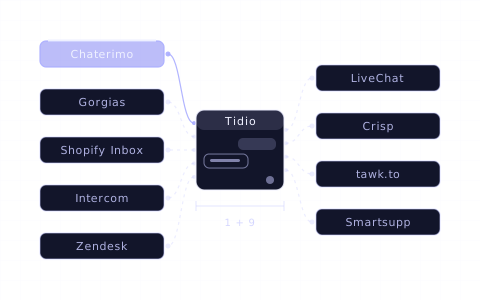
Article · Tidio alternatives
Tidio alternatives for online stores: AI chat compared
Tidio alternatives for online stores compared: AI answers from the catalogue, order status, live chat, e-commerce platforms and published prices.
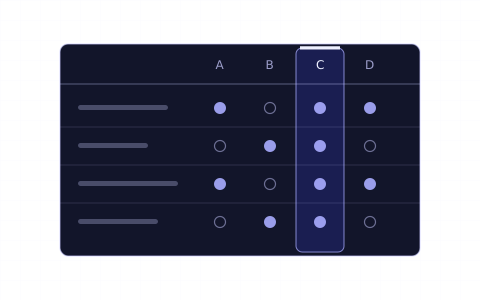
Article · LLM models
How to choose an LLM for customer support
Accuracy on your data, speed, cost and tone. How to compare ChatGPT, Claude, Gemini and Grok for an online store and test them on your own questions.
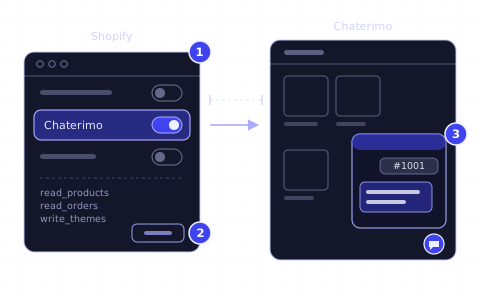
Guide · Shopify
Shopify AI customer service: set up Chaterimo
Install the Chaterimo app, turn on its app embed and let an AI chatbot answer product and order questions on your Shopify store, step by step.
Changelog
- Rewritten and moved to the new blog: Tidio's plans, Lyro and integrations checked on 20 October 2026, Chaterimo features checked in the app.
- Published.

